
Piano Tuning Rates
Patrick Brennan
Understanding the price of a piano tuning,
isn't just about comparing numbers.
It's about understanding what is being done, under what conditions, and for what result.
Standard Tuning
Montreal • Laval
North Shore • South Shore
This rate applies to a regularly maintained piano tuned under normal conditions.
- ✓ Clear and honest diagnostic
- ✓ No unnecessary work
- ✓ Professional in-home service
- Quick response by phone or text
Piano not tuned in a long time
The overall condition of the piano and the time elapsed since the last tuning can influence the required work. Additional working time, a pitch raise, or an action regulation may be necessary for a stable result. The rate is then adjusted according to the situation, after an evaluation.
Why prices may vary
Not all pianos are in the same condition. Two seemingly identical instruments may require very different amounts of work.
Time elapsed
A piano that hasn't been tuned for several years is often far from its normal pitch. In these cases, a single tuning is not always enough to stabilize the instrument.
The piano's actual condition
Age, wear, environment, humidity, tuning pin grip, internal structure... At a certain point, the piano reaches its mechanical limits.
The tuner's role is also to know how to recognize this limit.
Upright or Grand
The principle of tuning is the same, but access to the action, the time required, and the precision demanded can vary greatly depending on the type of piano.
How many tunings are necessary?
It's important to be clear: a heavily out-of-tune or old piano won't always stabilize in a single visit. Depending on the piano's condition, the work can be done in stages:
First tuning
Progressive pitch raise, without forcing the instrument.
Second tuning
Stabilization after the strings and structure have settled.
Third tuning
If necessary. Allows for the best possible result on a highly unstable piano.
It's not a matter of luxury. It's sometimes the only way to do serious and lasting work.
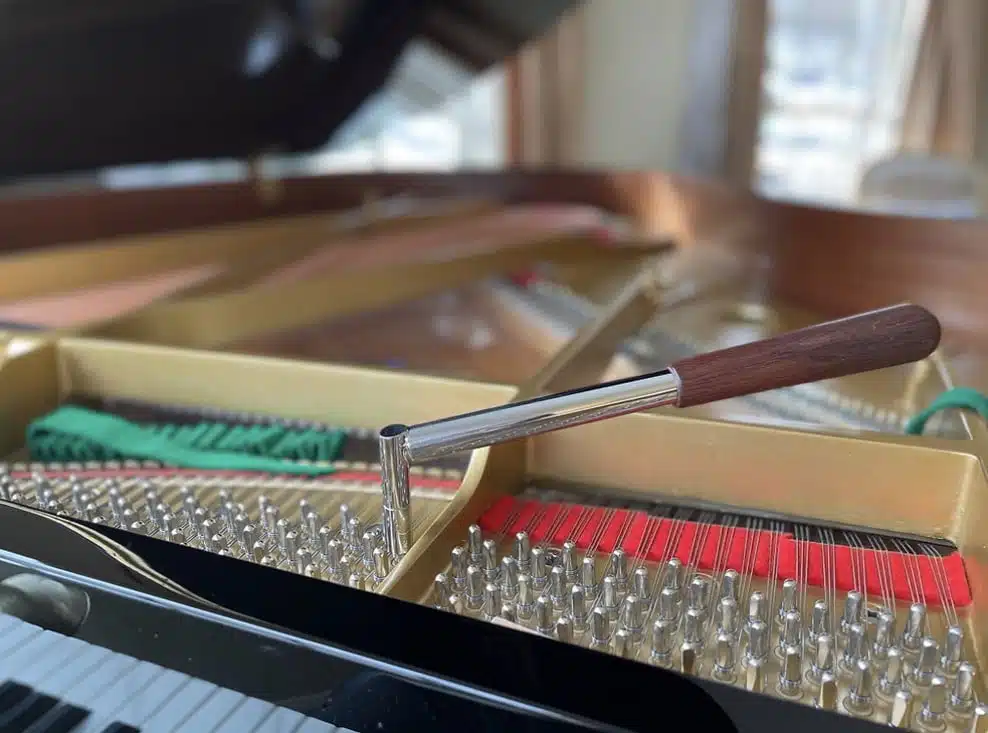

Why doesn't a tuning always hold?
Sometimes a client says: "Another tuner came recently, but the tuning didn't hold."
In many cases, the work wasn't bad, but the piano required more than one stage, or this wasn't clearly explained. Changing tuners doesn't change the mechanical reality of the piano.
- A tuning that doesn't hold isn't always a bad tuning.
- Often, it's a piano that just needed time.
Cheaper... or more expensive?
Price differences are explained by the time spent, experience, the level of standards, and the willingness to tell the truth about the piano's condition.
A very low price
- • A rushed tuning
- • Little or no evaluation
- • Unrealistic implicit promise
A fair rate
- • Honest diagnostic
- • Work done conscientiously
- • Taking accountability
The goal is not to upsell
The goal isn't to multiply interventions. The goal is to work with a strong professional conscience.
Nothing is forced. Everything is explained. The work is done in the best interest of the piano and the musician.
A good tuning isn't just a piano that sounds in tune today. It's a piano that holds over time, as much as its condition allows.
The trust of musicians
Read the feedback from those who have entrusted me with their instrument.